
Smart Storage
Modern SMD Component Storage: A Practical Guide for SMT and EMS Manufacturers
A practical guide to organizing SMD component storage for SMT and EMS manufacturing: reels, partial reels, locations, picking, traceability, line-side replenishment, and smart storage systems.
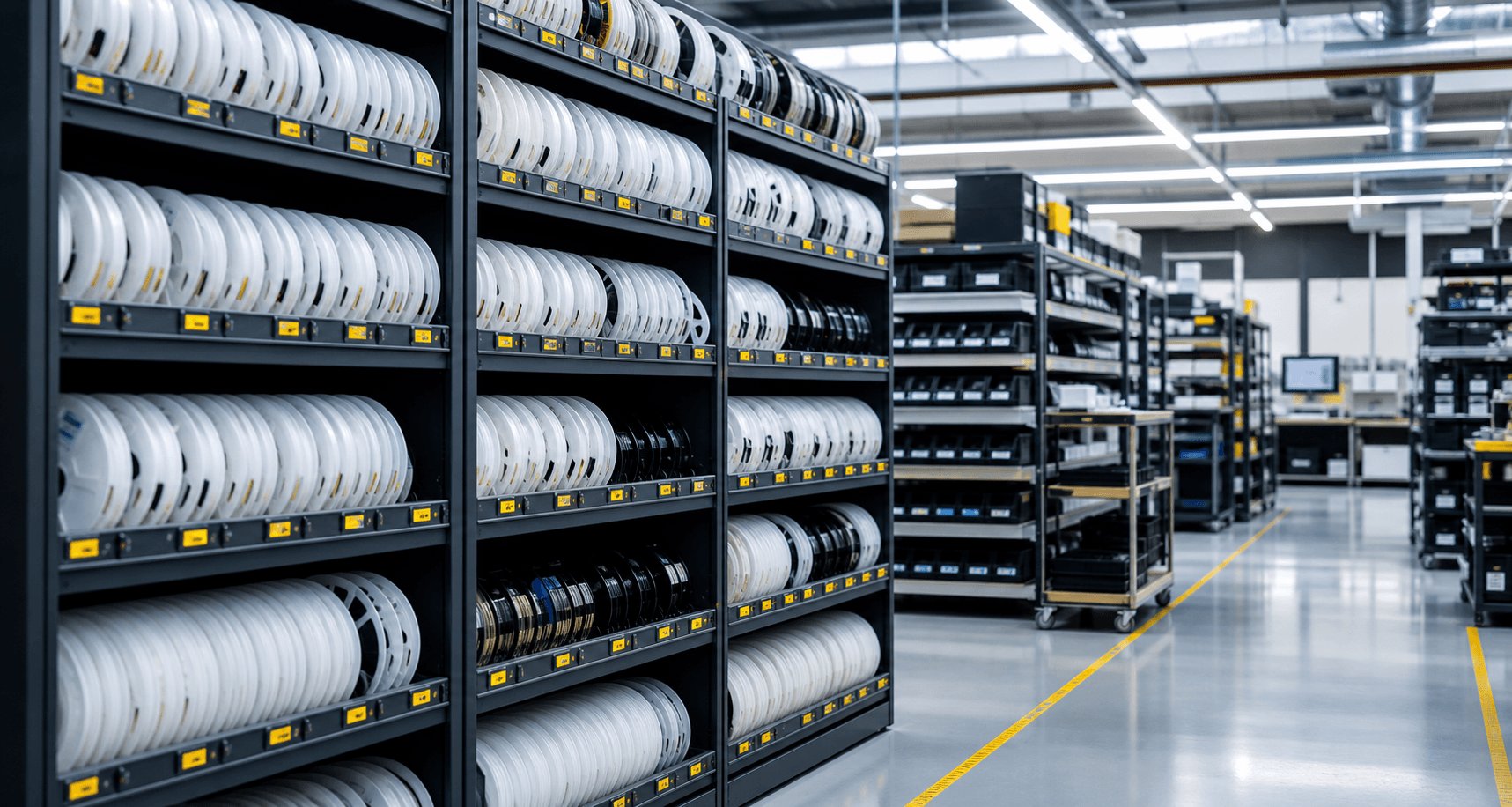
SMD component storage looks simple from the outside: reels, trays, sticks, boxes, labels, and warehouse locations.
In reality, it is one of the most important operational layers in SMT manufacturing. If components are hard to find, incorrectly reserved, stored in the wrong location, or not returned properly after production, the problem quickly moves from the warehouse to the production line.
For EMS and SMT manufacturers, storage is not just a passive place where materials wait. It is part of the production system.
A modern SMD storage process should help teams answer practical questions quickly:
- Where is the required reel?
- Is it available for this production order?
- Is there enough quantity left?
- Can an alternative component be used?
- Was this reel already assigned to another job?
- Has the material been moved to the line-side area?
- What was returned after production?
- Can this movement be traced later?
This guide explains how SMT and EMS companies can structure SMD component storage in a more reliable, scalable, and production-friendly way.
Why SMD Component Storage Is Different from General Warehouse Storage
A general warehouse usually deals with larger items, simpler picking logic, and more predictable storage units.
SMD component storage is different.
An SMT warehouse may contain thousands of small components, many of which look almost identical. One part number may exist across multiple reels, suppliers, batches, packaging types, and remaining quantities. A reel may be used partially, returned from production, reserved again, or shared across several orders.
Typical SMD storage units include:
- reels
- cut tapes
- sticks
- trays
- packs
- moisture-sensitive components
- partial reels
- production leftovers
- alternative components
This creates several operational challenges.
First, visual identification is not enough. Two reels can look similar but contain different components, different batches, or different remaining quantities.
Second, physical location matters. If a component exists in the system but cannot be found quickly, it is not truly available for production.
Third, production context matters. A reel is not only an inventory item. It may be connected to a specific order, BOM, SMT line, setup table, feeder, or replenishment task.
This is why SMD storage requires more than shelves and spreadsheets. It requires a clear material flow logic.
Common Problems in SMD Component Storage
Many SMT teams experience similar problems as production volume grows.
Components are physically present but hard to find
The system may show that a component exists, but operators still spend time searching for the correct reel. This usually happens when location tracking is incomplete, outdated, or too dependent on manual memory.
Reels are stored in several uncontrolled places
Components may be spread across the main warehouse, production area, line-side shelves, operator tables, carts, and return boxes. Without a unified storage process, the warehouse loses visibility over real availability.
Partial reels are not managed properly
After production, reels often return with reduced quantity. If this quantity is not updated or the reel is placed in an informal location, future planning becomes unreliable.
Operators pick the wrong reel
Mistakes happen when similar-looking components are stored near each other, labels are unclear, or picking is based only on printed lists.
Material is reserved twice
A reel may appear available but already be needed for another order. This creates conflicts during production preparation.
Traceability is reconstructed after the fact
Some companies treat traceability as a reporting task for audits. But if material movements are not captured during daily operations, traceability becomes manual, incomplete, and unreliable.
The warehouse and SMT line operate separately
When warehouse operations are not digitally connected with line preparation and replenishment, production teams often discover material problems too late.
What a Modern SMD Storage Process Should Support
A modern SMD storage process should support not only inventory control, but the full operational flow from receiving to production return.
At minimum, it should include:
- unique identification of each storage unit
- clear location tracking
- fast component search
- reservation for production orders
- support for alternative components
- partial quantity management
- guided picking
- return from production
- line-side replenishment
- traceability of movements
- integration with ERP, WMS, MES, or SMT line systems
The goal is not only to know what is in stock. The goal is to make material movement predictable, visible, and easy to execute.
Location-Based Storage: The Foundation of Reliable Material Flow
One of the most important principles in SMD storage is location-based component management.
Every reel, stick, tray, or package should be connected to a known physical location. That location may be a shelf cell, rack position, box, cart, operational warehouse zone, or line-side storage area.
Location-based storage helps operators answer the most basic question:
Where exactly is the component I need?
There are two common approaches.
Fixed location storage
In fixed location storage, each component or component group has a predefined place. This can be simple to understand, but it becomes inefficient when the number of components grows or when the same component exists in many reels and partial quantities.
Fixed storage can also waste space because locations may remain reserved even when empty.
Dynamic location storage
In dynamic location storage, components can be placed into available locations, while the system remembers where each item is stored.
This approach is more flexible and usually better for high-SKU SMT environments. However, it only works if every movement is scanned or confirmed in software.
For many EMS companies, the best approach is a hybrid one: controlled zones for certain material types, combined with dynamic positions inside those zones.
Why Smart Storage Racks Help
Smart storage racks bring software-guided logic into the physical warehouse.
Instead of relying only on printed lists or operator memory, smart racks can help operators find the right component faster and reduce picking mistakes.
Depending on the implementation, smart SMD storage racks may support:
- location indication
- pick-to-light guidance
- scanning of reels and storage cells
- confirmation of picking and return
- reservation of components for production orders
- real-time location updates
- integration with warehouse or production software
The key benefit is not only speed. The bigger benefit is process reliability.
When the rack, operator interface, and software work together, each movement becomes part of the digital material flow. The system knows where the reel was stored, when it was picked, for which order it was used, and whether it was returned.
This transforms the rack from passive storage equipment into production infrastructure.
Managing Partial Reels
Partial reels are one of the most common sources of inventory errors in SMT operations.
A full reel enters the warehouse with a known quantity. After production, part of the reel may remain. That remaining quantity must be updated and connected to the same physical reel identity.
If partial reels are not managed properly, several problems appear:
- the system shows more material than actually exists
- operators cannot find the remaining reel
- production orders are planned using unavailable quantity
- material is purchased unnecessarily
- traceability becomes incomplete
A good SMD storage process should define what happens after production:
- The reel is removed from the line or setup area.
- The remaining quantity is confirmed.
- The reel is returned to a known storage location.
- The system updates availability.
- The reel becomes available for future orders or remains reserved if needed.
This return flow is just as important as the initial picking flow.
Many companies improve picking first, but still leave returns informal. This creates a gap in the digital material flow.
Component Reservation for Production Orders
SMD storage is not only about what is available now. It is also about what must remain available for upcoming production.
Reservation logic helps prevent the same reel from being silently assigned to multiple orders.
A modern storage system should be able to connect components with:
- production orders
- BOM lines
- alternative components
- required quantities
- selected reels
- operational warehouse locations
- line-side preparation status
This is especially important when the same component can be used across several orders.
For example, one reel may contain enough quantity for two small jobs, but not for a third. Without reservation logic, operators may pick the reel for the wrong order, creating a shortage later.
Reservation also helps warehouse teams prepare materials before the SMT line requests them. Instead of reacting to shortages, the team can work from a structured list of required components.
Guided Picking and Error Reduction
Manual picking is one of the most error-prone parts of SMD storage.
Errors often happen because:
- components look similar
- locations are outdated
- printed lists are hard to follow
- operators are interrupted
- urgent production requests bypass the normal process
- returned reels are placed in temporary locations
Guided picking reduces this risk.
A guided picking process usually includes:
- The operator receives a picking task.
- The system shows the required component and location.
- The rack or interface indicates where to pick.
- The operator scans the reel.
- The system checks that the correct item was picked.
- The material is assigned to a production order, cart, box, or line-side area.
This does not remove the operator from the process. It makes the operator faster and more reliable.
For many SMT and EMS companies, this is a practical alternative to expensive full automation. The human still handles physical movement, but the software controls the logic.
Line-Side Replenishment and Operational Storage
In many SMT factories, the main warehouse is not the only important storage area.
There is often an operational storage zone near production. Components are brought there before being loaded onto setup tables or SMT lines.
This zone may contain:
- components prepared for current orders
- components waiting for upcoming jobs
- partially used reels
- materials returned from the line
- emergency replenishment items
- carts or boxes assigned to specific lines
If this area is not controlled digitally, it becomes a blind spot.
The warehouse may believe that a reel is already delivered, while production may still be waiting for it. Or production may return material without the warehouse knowing its new location.
A modern SMD storage process should treat operational storage as part of the same digital contour as the main warehouse.
The system should know not only that a reel exists, but also whether it is:
- in main storage
- reserved for an order
- picked into a box
- moved to operational storage
- delivered to a setup table
- loaded to the line
- returned after production
This is the difference between inventory tracking and material flow control.
Traceability Should Be Generated by Daily Operations
Traceability is often treated as a separate reporting layer. In that model, operators perform the work first, and documentation is completed later.
This creates weak traceability.
A better approach is operational traceability.
Operational traceability means that traceability data is generated naturally while people do their normal work:
- receiving components
- assigning storage locations
- picking reels
- moving material to production
- loading or preparing components
- returning partial reels
- updating quantities
If every movement is confirmed at the moment it happens, traceability becomes a by-product of the process.
This is especially valuable for EMS companies because production is often dynamic. Orders change, alternatives are used, partial reels return, and urgent jobs appear. The traceability system must reflect real operations, not only planned operations.
Integration with ERP, WMS, MES, and SMT Lines
SMD storage should not be isolated from the rest of the factory.
In a connected environment:
- ERP or planning systems provide orders, BOMs, and demand.
- Warehouse software manages storage, locations, and picking.
- MES or production systems manage execution.
- SMT line systems consume material and provide production context.
- Operators interact through scanners, tablets, terminals, or mobile devices.
The integration does not need to be perfect from day one. Many companies start with one or two key connections:
- importing production orders and BOMs
- importing component lists from ERP
- exporting picking status
- updating material availability
- connecting storage locations with production preparation
The important point is to avoid building another isolated database. Smart storage becomes much more valuable when it participates in the wider manufacturing flow.
Smart Racks vs Fully Automated Storage Towers
Fully automated storage towers can be powerful, especially in large operations with high material volume, strict environmental requirements, and enough budget.
But they are not the only path to modernization.
Smart racks offer a different automation model. They are usually simpler, more flexible, and easier to introduce step by step.
A practical comparison:
| Area | Smart Storage Racks | Automated Storage Towers |
|---|---|---|
| Initial cost | Usually lower | Usually higher |
| Flexibility | High | Medium |
| Physical access | Direct operator access | Machine-controlled access |
| Deployment complexity | Lower | Higher |
| Best for | Distributed storage, operational warehouse, line-side support, mid-size EMS | Centralized high-density automated storage |
| Automation level | Guided human operation | Higher mechanical automation |
| Scalability | Can grow step by step | Usually requires larger upfront planning |
For many EMS companies, smart racks are a realistic first step toward digital material flow. They help reduce manual search, improve traceability, and structure operations without requiring a full warehouse redesign.
A Step-by-Step Roadmap for Modernizing SMD Storage
Modern SMD storage does not have to be implemented all at once.
A practical roadmap may look like this:
Step 1: Identify every storage unit
Start by making every reel, tray, stick, or package identifiable. Use barcode, QR code, or existing supplier labels where possible.
Step 2: Define physical locations
Create a clear location model: warehouse zones, racks, shelves, cells, boxes, carts, and line-side areas.
Step 3: Connect components to locations
Make sure the system knows where each item is stored. Avoid uncontrolled temporary locations.
Step 4: Digitize picking tasks
Replace informal searching with task-based picking. Operators should know what to pick, where to pick it, and for which order.
Step 5: Add confirmation by scanning
Scanning reduces mistakes and keeps the system synchronized with reality.
Step 6: Control returns from production
Returned partial reels must be counted, confirmed, and placed into known locations.
Step 7: Connect storage with production orders
Import BOMs, order requirements, and alternative components from planning or ERP systems.
Step 8: Add smart rack indication
Use smart racks or pick-to-light logic to guide operators to the correct locations.
Step 9: Connect operational storage and line-side replenishment
Track not only main warehouse storage, but also movement to production areas.
Step 10: Use collected data for optimization
Once movements are digitized, the company can analyze search time, picking errors, shortages, storage utilization, and replenishment delays.
This is where AI and advanced optimization can become useful, but only after the basic material flow data is reliable.
Practical Checklist: Is Your SMD Storage Ready for Growth?
Use this checklist to evaluate your current process.
- Can operators find any reel without asking another person?
- Is every reel connected to a known location?
- Are partial reels updated after production?
- Can the system show which components are reserved for which orders?
- Are alternative components handled in a structured way?
- Can operators confirm picking by scanning?
- Is operational storage near the SMT line visible in the system?
- Can you trace component movement from warehouse to production?
- Do warehouse and production teams work from the same material status?
- Can you identify why a material-related delay happened?
If the answer is "no" to several of these questions, the storage process is probably limiting production efficiency.
How YAGA Approaches SMD Component Storage
YAGA is designed for SMT and EMS manufacturers that want to modernize SMD storage and material flow without jumping directly into expensive, complex automation.
The system combines smart storage hardware, connected software, and integration logic into one digital material flow.
YAGA helps teams:
- store SMD components in structured locations
- find reels faster
- guide operators during picking
- connect components with production orders
- manage operational storage near SMT lines
- support traceability through daily operations
- integrate warehouse data with production systems
- build a foundation for future smart carts, AGV delivery, and AI optimization
The goal is not only to improve warehouse order. The goal is to make SMD material flow more predictable, visible, and connected to production.
Conclusion
Modern SMD component storage is not just about shelves, boxes, or labels.
For SMT and EMS manufacturers, storage is part of the production infrastructure. It affects line preparation, changeover speed, material availability, operator workload, traceability, and production downtime.
A strong SMD storage process should connect physical locations, component identity, production orders, picking tasks, returns, and line-side replenishment into one digital flow.
Companies do not need to automate everything at once. A practical path starts with reliable identification, location-based storage, guided picking, return control, and integration with production demand.
Once this foundation is in place, smart racks, carts, AGV robots, and AI-based optimization become much more useful.
SMD storage modernization is not only a warehouse project. It is a production reliability project.
Ready to modernize your SMD storage process?
YAGA helps SMT and EMS manufacturers connect smart racks, material flow software, and production integration into one practical system.
Talk to YAGA
Ready to discuss a smarter SMD material flow?
Share your storage, kitting, or line-side replenishment challenge and we will help shape a practical pilot.