
Smart Storage
Smart SMD Storage Systems: What We Can Use in 2026
A practical guide to smart SMD storage systems available for SMT and EMS manufacturers in 2026: smart racks, pick-to-light, mobile storage, dry cabinets, automated towers, X-ray counting, AGV integration, and material-flow software.
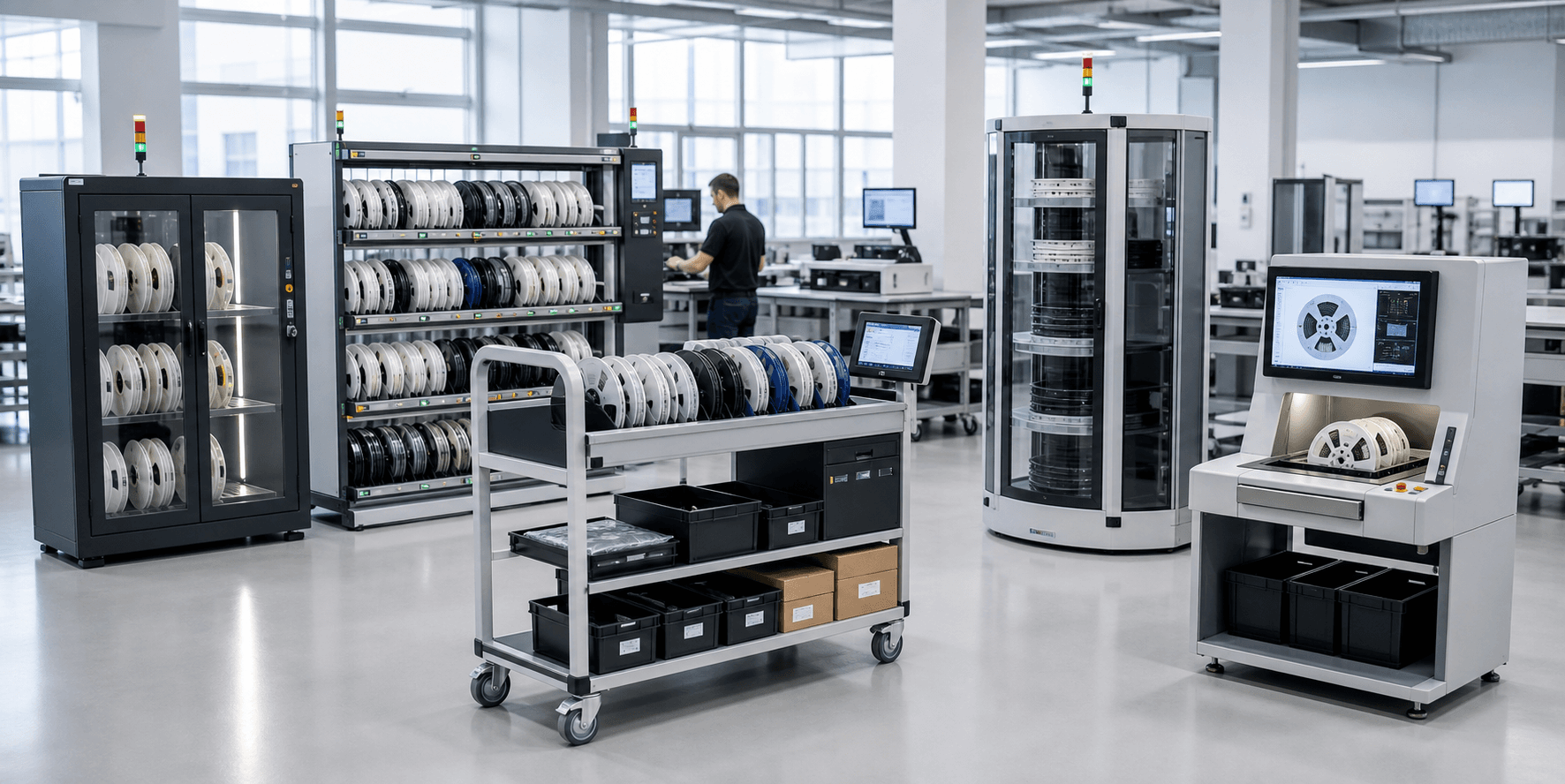
SMD component storage is no longer just a question of shelves, boxes, and warehouse discipline.
In 2026, SMT and EMS manufacturers have several realistic options for improving component storage and material flow. These options range from simple barcode-based storage to pick-to-light smart racks, mobile smart storage, automated SMD towers, dry storage cabinets, X-ray component counters, AGV-connected logistics, and integrated material-flow software.
The important question is not simply:
Which storage system is the most advanced?
The better question is:
Which storage system fits our production process, budget, material volume, and automation maturity?
For many EMS companies, the best answer is not one large machine. It is a practical combination of storage hardware, operator guidance, scanning, software, and integration with production.
This article explains what smart SMD storage systems SMT and EMS manufacturers can use in 2026, where each option makes sense, and how to choose a practical modernization path.
Why SMD Storage Needs a Dedicated System
SMD components are difficult to manage with generic warehouse logic.
An SMT warehouse may contain thousands of reels, sticks, trays, cut tapes, moisture-sensitive parts, partial reels, and alternative components. Many items look similar. Many have different quantities, batches, suppliers, date codes, and production constraints.
The warehouse also needs to support production, not only inventory.
A reel may be:
- available in main storage
- reserved for a production order
- picked into a kit
- moved to operational storage
- delivered to a setup table
- loaded near the line
- partially consumed
- returned after production
- blocked because of quality, moisture, or traceability rules
This means SMD storage must answer more than "how many components are in stock?"
It must also answer:
- where the component is located
- whether it is available for this order
- whether it has already been reserved
- whether an alternative component is allowed
- how much quantity remains
- where the reel moved after production
- whether the movement is traceable
That is why modern SMD storage is becoming part of the SMT material-flow system.
What "Smart SMD Storage" Means in 2026
A smart SMD storage system usually combines physical storage with digital control.
It may include:
- unique component identification
- barcode or QR-code scanning
- exact location tracking
- pick-to-light indication
- operator terminals or tablets
- smart shelves or smart racks
- automated storage towers
- dry cabinets for moisture-sensitive components
- X-ray component counting
- integration with ERP, MES, WMS, or SMT line software
- traceability records
- reservation logic
- return-flow management
- analytics and optimization
The system becomes "smart" when it can guide the operator, update material status, and connect physical movement with digital production context.
A rack alone is not smart.
A scanner alone is not smart.
A software table alone is not smart.
The value appears when the rack, operator action, component identity, storage location, and production requirement work together.
Main Types of SMD Storage Systems Available in 2026
In 2026, SMT and EMS companies can choose from several categories.
The most common options are:
- Manual racks with barcode-based software
- Pick-to-light smart racks
- Mobile smart racks and smart carts
- Dry cabinets and MSD-controlled storage
- Automated SMD storage towers
- X-ray counting and incoming inspection systems
- Integrated material-flow software
- AGV-connected storage and delivery
- Hybrid systems combining several of the above
Each option solves a different part of the material-flow problem.
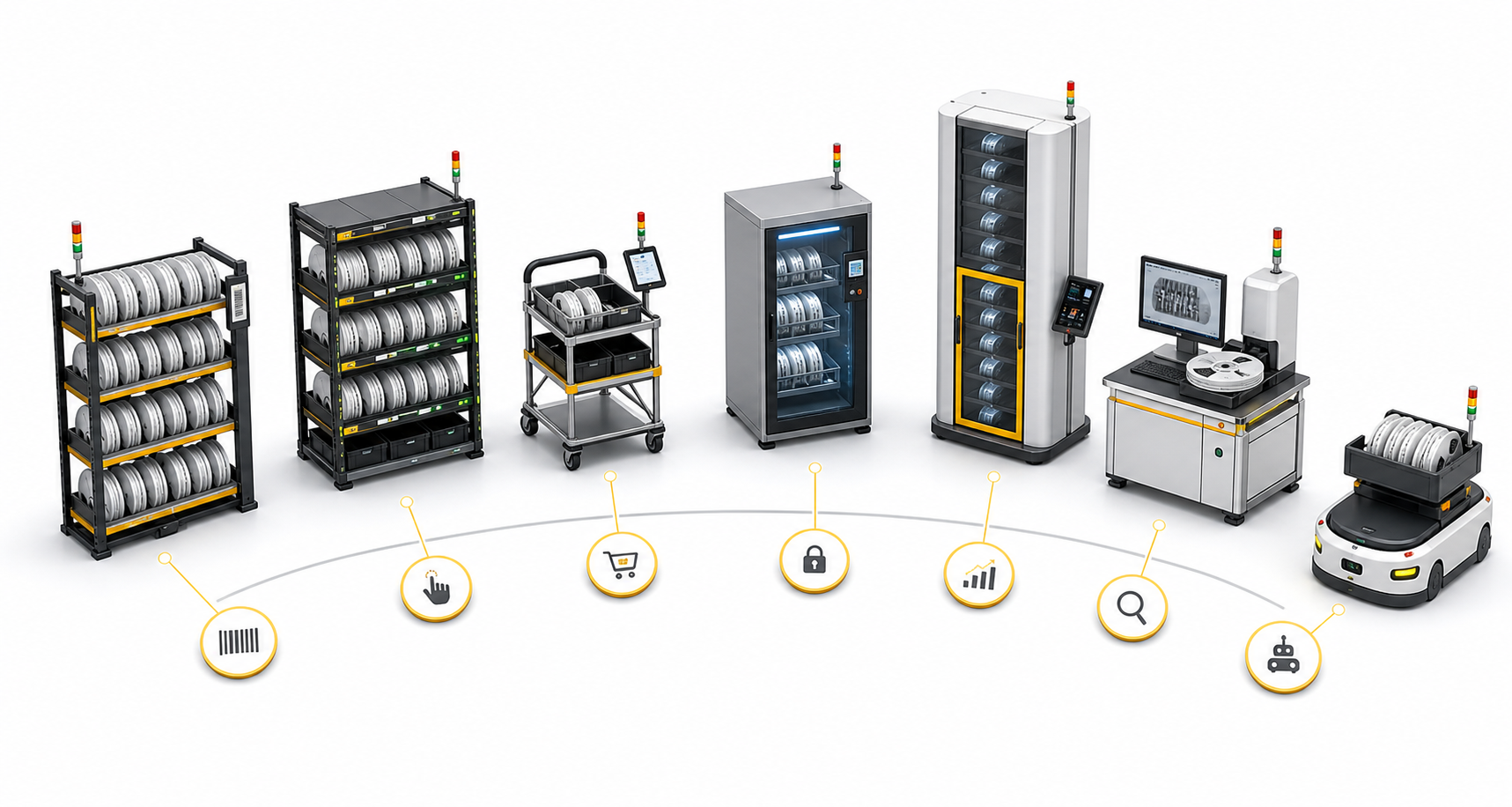
Smart SMD storage is not one machine. It is a set of storage, counting, movement, and software options that should match the real production bottleneck.
1. Manual Racks with Barcode-Based Software
This is the simplest modernization step.
The company keeps relatively simple physical storage, but adds disciplined identification and software control.
A basic barcode-based storage system may include:
- labeled storage locations
- barcode or QR-code labels on reels
- scanning during receiving
- scanning during put-away
- scanning during picking
- scanning during return
- software that connects components with locations
This approach is useful when the company wants to improve visibility without immediately buying advanced hardware.
Advantages
- Low initial cost
- Easy to start
- Can use existing racks
- Good first step toward digital storage
- Builds data discipline
- Helps operators find components faster
Limitations
- Still depends heavily on operator discipline
- No physical light indication
- Picking may still be slower than with smart racks
- Errors can happen if operators skip scanning
- Harder to scale when component volume grows
Best fit
Manual racks with barcode software are a good fit for small SMT operations, early-stage EMS companies, or factories starting their first digital storage project.
This is often the right first step before adding smart racks or automated towers.
2. Pick-to-Light Smart Racks
Pick-to-light smart racks are one of the most practical smart storage options for SMT and EMS companies.
In a pick-to-light system, the software guides the operator to the correct physical location. A light indicator shows where to pick or place the component. The operator confirms the action by scanning or pressing a confirmation button, depending on the system design.
This reduces manual search and helps prevent picking mistakes.
What pick-to-light racks can support
- guided picking
- guided put-away
- location-based storage
- work-order-based picking
- reel-to-location mapping
- faster operator onboarding
- reduced search time
- improved traceability
- integration with material-flow software
Advantages
- More affordable than full automated towers
- Faster to deploy
- Good for distributed storage
- Good for operational warehouse near production
- Operators still have direct access to material
- Can be expanded step by step
- Useful for small and mid-size EMS companies
Limitations
- Not fully automated
- Still requires human movement
- Requires good location discipline
- May need careful rack layout planning
- Works best when connected to real production tasks
Best fit
Pick-to-light smart racks are a strong fit for EMS companies that want practical automation without the cost and complexity of full automated storage towers.
They are especially useful for:
- high-mix production
- frequent changeovers
- operational storage near SMT lines
- manual picking improvement
- line-side replenishment
- partial reel return control
For many companies, pick-to-light racks are the most realistic bridge between manual storage and fully automated material logistics.
3. Mobile Smart Racks and Smart Carts
Not all SMD storage should be fixed.
In many factories, components move through an intermediate area between the main warehouse and the SMT line. This area may contain boxes, carts, kits, setup materials, returned reels, and urgent replenishment items.
Mobile smart racks and smart carts help control this movement.
A smart cart can act as:
- mobile storage
- a kit carrier
- a line-side buffer
- a delivery unit
- a temporary operational warehouse location
- a bridge between warehouse and production
Advantages
- Brings material closer to production
- Supports line-side replenishment
- Helps organize kitting
- Reduces uncontrolled boxes and temporary locations
- Can be used before AGV automation
- Useful in flexible production environments
Limitations
- Requires software visibility
- Can become chaotic if carts are not tracked
- Needs clear rules for loading, delivery, and return
- Does not solve main warehouse problems by itself
Best fit
Mobile smart racks and smart carts are useful when the company already has a basic storage process but struggles with the movement between warehouse, operational storage, setup tables, and SMT lines.
They are especially relevant for EMS factories with:
- several SMT lines
- frequent changeovers
- operational storage near production
- manual delivery between warehouse and line
- plans to introduce AGV robots later
A smart cart is often a practical intermediate step before robotic delivery.
4. Dry Cabinets and MSD-Controlled Storage
Some components require controlled storage conditions.
Moisture-sensitive devices need special handling because exposure to humidity can create production and reliability risks. For these components, ordinary racks are not enough.
Dry cabinets and dry storage systems help control moisture-sensitive materials.
A modern dry storage setup may include:
- humidity-controlled cabinet
- barcode-based registration
- exposure time tracking
- material status tracking
- integration with inventory software
- alerts for storage or handling rules
- connection to production preparation
Advantages
- Supports proper handling of moisture-sensitive components
- Helps reduce quality risk
- Can be integrated into material traceability
- Useful for high-reliability electronics manufacturing
Limitations
- Solves only part of the storage problem
- May be expensive if used for all material
- Requires process discipline around exposure and return
- Should be connected with the wider material-flow system
Best fit
Dry storage is important for manufacturers working with moisture-sensitive components, automotive electronics, medical electronics, aerospace electronics, industrial electronics, and other reliability-sensitive products.
The key is to avoid treating dry cabinets as isolated equipment. They should be part of the same material-flow system as the main warehouse and production process.
5. Automated SMD Storage Towers
Automated SMD storage towers are high-density storage systems designed specifically for component reels.
They typically store reels inside a vertical machine and retrieve them automatically when requested by the system.
Automated towers can provide:
- high-density reel storage
- automated in/out operations
- compact floor-space usage
- controlled access
- reduced manual search
- inventory accuracy
- FIFO or FEFO control
- integration with ERP, MES, or material-flow software
- traceability of storage and retrieval events
Advantages
- High storage density
- Fast automated retrieval
- Reduced operator search time
- Strong inventory control
- Good for centralized storage
- Can support high-volume operations
- Can improve traceability and stock accuracy
Limitations
- Higher initial cost
- Higher deployment complexity
- More dependent on vendor ecosystem
- May require process redesign
- Not always ideal for distributed line-side storage
- Can become a bottleneck if all material flow depends on one machine
- Less flexible for unusual packaging or mixed operational storage needs
Best fit
Automated SMD towers make sense when the company has:
- high reel volume
- limited floor space
- centralized material storage
- strong need for inventory accuracy
- enough budget for larger automation
- stable process discipline
- integration capability with ERP/MES/WMS systems
They are especially useful for larger EMS companies and high-volume SMT operations.
However, a tower should not be seen as the only smart storage option. For many small and mid-size EMS companies, smart racks and good software may provide a better first step.
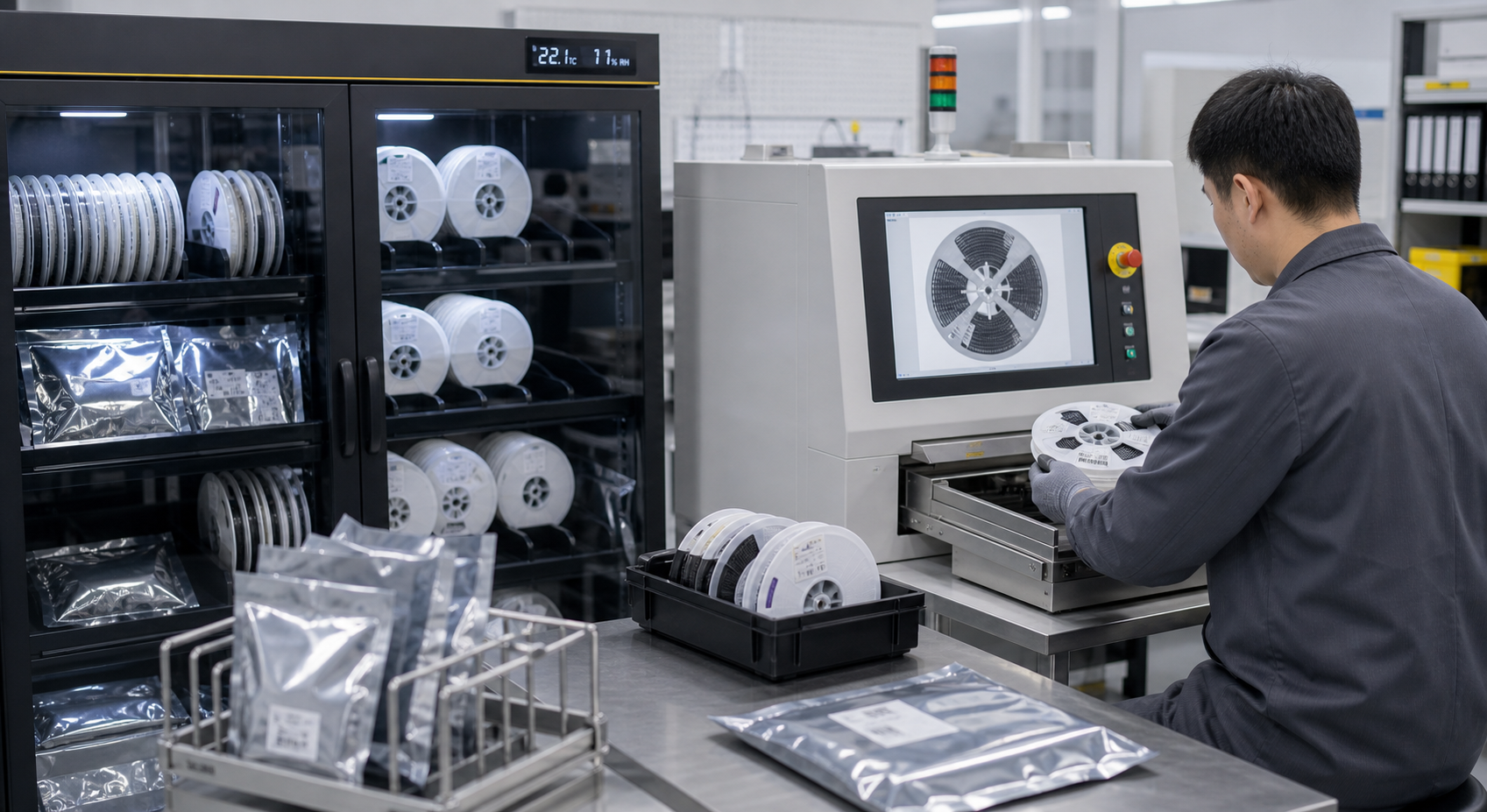
Specialized equipment such as dry cabinets and X-ray counters is most useful when it is connected to the same material-flow software as ordinary storage.
6. X-Ray Component Counting and Incoming Inspection
Storage accuracy depends on quantity accuracy.
If the system does not know how many components remain on each reel, planning becomes unreliable.
X-ray component counters help count components on reels without unwinding them. They are especially useful during:
- incoming inspection
- inventory audit
- return from production
- partial reel verification
- shortage investigation
- reconciliation between system and physical stock
Advantages
- Fast quantity verification
- Useful for partial reels
- Supports inventory accuracy
- Reduces manual counting
- Helps improve planning confidence
- Can support traceability and audit requirements
Limitations
- Does not organize storage by itself
- Requires integration with inventory or material-flow software
- Adds equipment cost
- May not be necessary for every company at early stage
Best fit
X-ray counting is useful when partial reel accuracy is a major problem, or when the company has strict planning, traceability, and inventory requirements.
It is most valuable when connected to receiving, storage, picking, and return workflows.
7. Integrated Material-Flow Software
Hardware is only one part of smart SMD storage.
The software layer is what connects storage with production.
A good material-flow software system should support:
- component registration
- location management
- storage status
- production order import
- BOM and alternative components
- material reservation
- picking tasks
- kitting
- operational warehouse movement
- line-side replenishment
- return from production
- partial reel updates
- traceability
- integration with ERP, WMS, MES, and SMT line systems
The software should not simply display inventory. It should manage transitions between material states.
Example states:
- received
- stored
- reserved
- picked
- prepared
- moved to operational warehouse
- delivered to setup table
- delivered to line
- consumed
- partially returned
- available again
- blocked
- missing
This is where many storage projects succeed or fail.
A company can buy advanced racks or towers, but if the software does not match the real material process, operators will create workarounds.
Best fit
Integrated material-flow software is necessary for almost every modern SMD storage project.
It becomes especially important when the company uses several storage types at once:
- smart racks
- dry cabinets
- towers
- carts
- line-side locations
- manual racks
- scanners
- AGV delivery
Without integrated software, each storage system becomes a separate island.
8. AGV-Connected Storage and Delivery
AGV robots can automate internal transport between warehouse, operational storage, and production.
In SMT material flow, AGV robots may deliver:
- prepared kits
- component boxes
- smart carts
- replenishment materials
- returned reels
- empty containers
However, AGV robots should be introduced only when the material process is already structured.
An AGV needs clear answers:
- what should be transported?
- where is it now?
- where should it go?
- who requested it?
- which production order is it connected to?
- how will delivery be confirmed?
- what happens after production returns the material?
If these answers are missing, AGV automation will not solve the root problem.
Advantages
- Reduces manual transport
- Supports repeatable delivery routes
- Can improve line-side replenishment
- Useful for larger factories
- Can connect warehouse and production physically
Limitations
- Requires stable process logic
- Requires reliable storage and task data
- Requires factory layout planning
- Does not fix inventory errors by itself
- May be unnecessary for small operations
Best fit
AGV-connected storage is suitable for companies that already have reliable storage data, controlled picking, structured operational warehouse processes, and repeatable delivery routes.
For many EMS companies, AGV should come after smart storage and digital material flow, not before.
Comparison: Which SMD Storage System Fits Which Need?
| Need | Best-fit option |
|---|---|
| Start digitizing storage with low cost | Barcode-based manual racks |
| Reduce search time and picking errors | Pick-to-light smart racks |
| Organize material near production | Mobile smart racks or smart carts |
| Control moisture-sensitive components | Dry cabinets or dry storage systems |
| Store many reels in limited space | Automated SMD storage towers |
| Verify quantities on partial reels | X-ray component counting |
| Connect warehouse with production | Material-flow software |
| Automate internal transport | AGV-connected delivery |
| Build step-by-step automation | Hybrid smart storage system |
The best system depends on the factory's real bottleneck.
If operators spend time searching, start with location-based storage and pick-to-light.
If partial reel accuracy is poor, add return control and counting.
If floor space is the main issue, consider towers.
If line-side delivery is chaotic, improve operational storage and carts.
If teams work in disconnected systems, focus on integration software first.
Smart Racks vs Automated Towers
A common question is whether SMT companies should choose smart racks or automated towers.
The answer depends on the production context.
Smart racks are usually better when:
- budget is limited
- deployment must be fast
- storage is distributed
- operators need direct access
- the company wants step-by-step modernization
- operational storage near the line is important
- flexibility matters more than full automation
Automated towers are usually better when:
- reel volume is very high
- floor space is limited
- centralized storage is preferred
- the company has strong integration capability
- budget allows larger upfront automation
- the process is stable enough for automated retrieval
Many factories need both
A mature SMT material-flow system may use automated towers for centralized high-density storage and smart racks or carts for operational storage near production.
The question is not "rack or tower?"
The better question is:
Which storage layer should each system support?
For example:
- main warehouse: tower or high-density storage
- operational warehouse: smart rack
- line-side buffer: smart cart
- sensitive components: dry cabinet
- quantity verification: X-ray counter
- process control: material-flow software
This layered approach is often more practical than expecting one system to solve everything.
A Practical 2026 Architecture for Smart SMD Storage
A modern SMD storage architecture can be designed as a connected material-flow system.
ERP / Planning Systems
        ↓
Production Orders and BOMs
        ↓
Material-Flow Software
        ↓
Main Storage
  ├─ Smart Racks
  ├─ Manual Barcode Racks
  ├─ Automated Towers
  └─ Dry Cabinets
        ↓
Picking and Reservation
        ↓
Operational Warehouse
  ├─ Boxes
  ├─ Smart Carts
  └─ Line-Side Storage
        ↓
SMT Lines / Setup Tables
        ↓
Return Flow
        ↓
Updated Inventory and Traceability
The key principle is that every physical movement should update the shared digital material status.
This allows warehouse, production, planning, and quality teams to work with the same information.
Recommended Modernization Path for Small and Mid-Size EMS Companies
Many EMS companies cannot justify a large automated tower project immediately.
A practical modernization roadmap may look like this:
Step 1: Digitize component identity and locations
Start with barcodes, QR codes, location labels, and basic software discipline.
Step 2: Control receiving and put-away
Make sure every incoming reel or package enters the system with a known identity and storage location.
Step 3: Add production-order-based reservation
Connect storage with real production demand. Components should be reserved for jobs, not only stored as stock.
Step 4: Introduce guided picking
Use software tasks and scanning to reduce manual search and picking errors.
Step 5: Add pick-to-light smart racks
Use smart racks where search time, picking mistakes, or operator workload are highest.
Step 6: Control operational storage near SMT lines
Track materials after they leave the main warehouse. Boxes, carts, and line-side locations should be visible.
Step 7: Improve return flow
Returned partial reels must be scanned, counted, updated, and placed into known locations.
Step 8: Add specialized equipment where needed
Add dry cabinets, X-ray counters, automated towers, or AGV robots based on real bottlenecks.
Step 9: Use analytics and AI only after data becomes reliable
AI-based optimization becomes useful when the system already captures real movement data.
This path avoids over-automation and builds a foundation step by step.
When a Company Is Ready for Smart SMD Storage
A company is probably ready for smart SMD storage if several of these statements are true:
- Operators often search for reels manually.
- The same component exists in several uncontrolled places.
- Partial reels are difficult to track.
- Production sometimes waits for missing material.
- Warehouse and production have different material status.
- Kitting is managed with paper lists or spreadsheets.
- Returned reels are not processed consistently.
- Alternative components are handled informally.
- Stock is available in the system but hard to find physically.
- Traceability requires manual reconstruction.
- The company wants to grow without adding more warehouse operators.
- The company needs affordable automation before investing in larger systems.
These are signs that the issue is not only storage capacity. The issue is material-flow control.
What to Avoid When Choosing a Smart Storage System
Avoid buying hardware without process design
A smart rack or tower will not help if the company has not defined receiving, picking, kitting, return, and reservation logic.
Avoid isolated storage systems
If the storage system cannot exchange data with production planning, ERP, MES, or warehouse software, it may create another information silo.
Avoid ignoring operational storage
Many problems happen after material leaves the main warehouse. Line-side areas, setup tables, boxes, and carts must also be part of the system.
Avoid over-automation too early
AGV robots and automated towers are useful, but only when the basic material data is reliable.
Avoid focusing only on inventory quantity
In SMT manufacturing, location, status, reservation, movement, and traceability are just as important as quantity.
How YAGA Approaches Smart SMD Storage
YAGA is designed for SMT and EMS manufacturers that want practical, affordable, and integrated smart storage.
Instead of treating storage as isolated equipment, YAGA connects smart hardware, operator workflow, and material-flow software into one digital contour.
YAGA helps teams:
- structure SMD component storage
- connect reels and packages with exact locations
- guide operators during picking
- support operational storage near SMT lines
- reserve components for production orders
- manage boxes, carts, and line-side movement
- control return of partial reels
- improve daily traceability
- integrate warehouse data with production systems
- prepare the foundation for smart carts, AGV robots, and AI optimization
The goal is not to replace every human action with a machine. The goal is to make the correct material movement visible, guided, confirmed, and connected to production.
For many EMS companies, this is the most practical path to smart storage in 2026.
Conclusion
In 2026, SMT and EMS companies have many options for smart SMD storage.
They can use barcode-based racks, pick-to-light smart racks, mobile smart storage, dry cabinets, automated towers, X-ray counters, AGV delivery, and integrated material-flow software.
But the best solution is rarely one isolated device.
The best solution is a storage architecture that matches the real material flow: receiving, main storage, reservation, picking, kitting, operational warehouse, line-side delivery, production use, return, and traceability.
For small and mid-size EMS companies, the most practical path is usually step-by-step modernization:
- Make components identifiable.
- Make locations reliable.
- Connect material with production orders.
- Guide picking.
- Control operational storage.
- Manage returns.
- Add smart racks, carts, towers, counters, or AGV robots where they solve a real bottleneck.
Smart SMD storage is not only about storing components better.
It is about making the whole SMT material flow more predictable, visible, and reliable.
Ready to modernize your SMD storage system?
YAGA helps SMT and EMS manufacturers connect smart racks, carts, material-flow software, and production integration into one practical smart storage platform.
Talk to YAGA
Ready to discuss a smarter SMD material flow?
Share your storage, kitting, or line-side replenishment challenge and we will help shape a practical pilot.